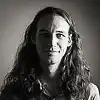
After a decade writing and gathering materials, Hien recently published her debut album, “Trăng Qua.”
“Trăng Qua” is a record that was 10 years in the making. Some initial song ideas came up in 2015, while other new songs were started in 2025. The album wasn’t constructed from a fully formed concept right from the beginning. Instead, Hien wrote the tracks one by one, polished them across different times in her life, and only came to realize their common thread after a while.
During the creation of the album, there have been many changes in the life and musical artistry of Hien. Born Nguyễn Thanh Hiền in Budapest into a Vietnamese family, Hien moved to New York a few years ago. Her life experiences pass through three languages and cultures. Vietnamese is the language of family and heritage; Hungarian is closely connected to her formative years in Budapest; and English has become the language of daily life and creativity while she lives in the US.

The album cover.
To Hien, the extended period making “Trăng Qua” also gave some old compositions a chance to revisit a past version of herself.
Hien describes her songwriting process as “quite simple”: she begins with the sound, then the melody, and finally the lyrics. Still, over the decade, the person behind that process has changed.
“‘Trăng Qua’ has had more time to mature,” Hien shares. She mentions “Bloom,” the EP she released in 2021, as a stepping stone before she transitioned to the full-length album. “I’ve matured — I became a mature woman and a mature artist,” she explains. “I’m very glad to have put some of these songs down for a while, as once I return to them, I could listen to them with a fresher perspective. I’m also much bolder in my creative choices. I stopped chasing perfection and let the production be more rustic and authentic.”

Hien describes her songwriting process: starting with the sound, then the melody, and finally the lyrics.
For songs that have been kept on the back burner for years, taking them out for polishing does not mean retaining how they were first created. Hien believes that letting go of one’s older versions is a natural part of growth.
“Letting go of my old selves is really not difficult, because I simply have grown out of them. It’s a part of growth, of creating a space for someone you’re becoming.”
Those changes are clearly shown in Hien's treatment of her musical materials. “Trăng Qua” swings between electronic, ambient, and pop, employing elements from different influences, specifically bolero, chèo, cải lương, Hungarian Romani folk music, Latin bolero, Bulgarian choral music, R&B, and hip-hop.
Hien wasn’t hung up on recreating traditional elements as is, but picked those that she feels a pull towards, including melody, vocal technique, arrangement, rhythm, and emotivity. She then incorporated them into her own music-making process.
‘Trăng tàn trên hè phố’ (lit: the moon wanes on the street) is Hien’s first-ever release in Vietnamese, which made over a composition by Phạm Thế Mỹ using bolero, drum and bass. In ‘next to you,’ she integrated a sample from ‘Xa mối tình đầu’ (lit: away from my first love), also known as ‘Đoạn tái bút 2’ (lit: postscript no. 2) composed by Tú Nhi and Bằng Giang. In ‘through this phase,’ another segment from ‘Tình thư hạ vị’ (a chèo classic) performed by Minh Thu and Khắc Tư becomes part of an electronic track.

At the photoshoot for “Trăng Qua.”
Hien’s own relationship with Vietnam was formed in a similar way. She grew up in Hungary in a Vietnamese family instead of spending her formative years in Vietnam. This background resulted in a certain distance that always exists in how she connects to Vietnamese culture and music.
The music video for ‘Bloom’ documents the life of young girls in the matriarchal community of M’Nông people. Stories about family, roots, culture, and nature continue to be crucial themes in Hien’s music.
“I will never experience Vietnamese culture exactly like someone who was born and grew up there, speaking Vietnamese as a native tongue,” she explains. “But that distance also gives me an alternative perspective. It lets me realize, respect, and appreciate things that someone who grew up in Vietnam might deem obvious.”
Hien doesn’t see this distance as something to hide in her music. On the contrary, it’s become a part of how she explores her heritage: “I still have many things to learn about Vietnam, and I think that constant discovery is also a part of my music.”
One aspect of this journey comes from her family, especially her grandfather Trần Tượng Tư, a cải lương performer hailing from Bạc Liêu in the Mekong Delta. He could play đàn nguyệt, đàn nhị, guitar, and violin and worked at the Trần Hữu Trang Cải lương Theater in Saigon, and then the National Cải lương Theater in Hanoi.
In her childhood, she spent summers with her grandparents, so she can remember how he spontaneously played cải lương on the guitar. Years later, Hien hunted down some of his old recordings and added a segment of his guitar work into ‘trăng ơi,’ a track on the album. Hien sees this as a way to continue making music with her grandpa, even though they come from different musical periods.
The music video for ‘Jetplants’ is constructed from VHS footage of Hien’s family archive, spanning three locations and multiple generations.
Her family story also directly appears in ‘Jetplanes,’ the 15th track of the album. It reflects the journey to find new homes and the experiences of someone living away from home, a reference to how her family left Vietnam for Hungary and how she left Budapest for Brooklyn.
The music video is constructed from old VHS footage of her family, filmed in Vietnam and Hungary. 1992 scenes in a small town near Hải Phòng show her father’s side of the family, while those in Hanoi chronicle family meals, Tết celebrations, birthday karaoke sessions, and her maternal grandparents. The footage in Budapest shows a small family and Hien’s childhood friends.
These video snapshots not only help illustrate the song’s visual side, but also tell the story of places and people that have a role in Hien’s personal narrative, from Vietnam to Hungary and then the US.
“Trăng Qua” features lyrics in Vietnamese, Hungarian, and English, sometimes in one song. For Hien, each language is connected to a different part of her life, but they coexist in one album formed in Brooklyn.
Singing in Vietnamese was a skill she had to relearn. She used to feel self-conscious about singing in Vietnamese before deciding to bring it to her music. The track ‘Trăng tàn trên hè phố’ is the first step in that journey, followed by many other instances where Vietnamese shows up across the album.
Hien doesn’t look at Vietnam as someone who has learned everything about the place they belong. It’s a continual process of discovery via family, language, music, and inherited memories.
“Trăng Qua” pieces together songs from different periods of Hien’s life. Some had their start when she was still in Budapest; others were finished when she moved to America. In between them were many shifts in living arrangements, language, music, and even the self.
Following the album release, Hien hopes to return to Vietnam for a month during Tết to perform.
“Trăng Qua” is available on Bandcamp on major streaming platforms.