What is culture? For someone who writes for an arts and culture publication, you’d think I’d have a quick and clean answer, but the more I ruminate, the more I realize it comes down to a sloppy assemblage of habits, ephemera, and minutiae: eating preferences, holiday attire, styles of sneezes, methods for counting on one’s fingers, variety of fruits to gift and an endless string of social norms. Pile enough of these choices together, and you end up with a distinct culture.
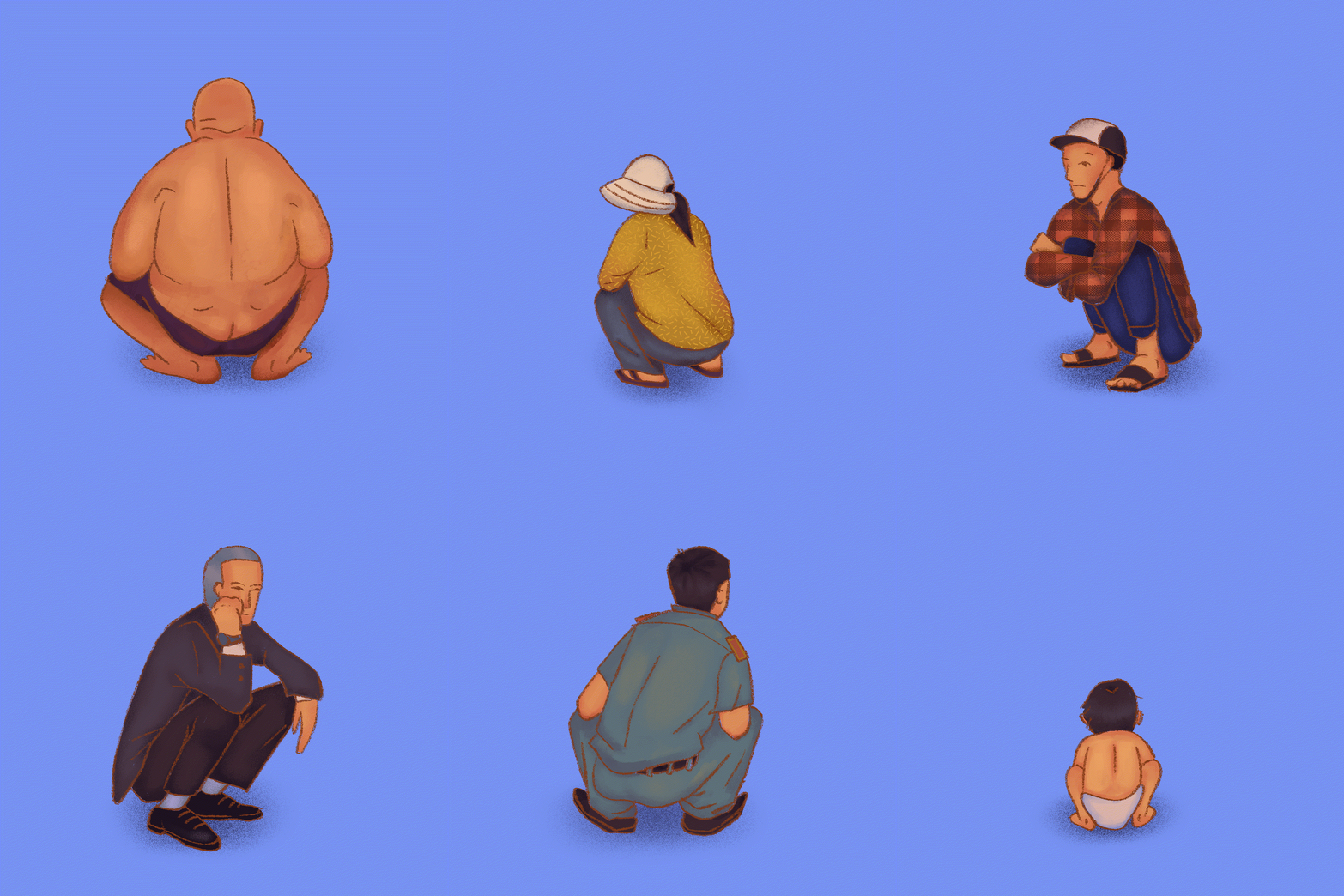
If one were to thus try and compile the many disparate points that comprise Vietnamese culture, one must make space for ngồi chồm hổm. As its oft-used English equivalent, “Asian squat,” attests to, the style of crouching low to the ground, perfectly balanced without a chair, is common across Asia broadly. Still, it is such a frequent sight in Vietnam, evidenced by the many social media posts foreigners make about it, that we should consider it an element of Vietnamese culture.

For illustrative purposes only and not guaranteed anatomical accuracy.
In these online discussions, westerners often admit to being wholly unable to chồm hổm. If you take a poll of your foreign friends and co-workers, you’ll likely find this to be true. But why? While there are plenty of theories as to why foreigners rarely can, it has less to do with the minor differences in body types and anatomies across ethnicities, and more to do with practice. To squat, one must have flexible ankles. Kids have these and thus are observed across cultures to be rather good at squatting. But unless one practices regularly, the body, like the mind, naturally becomes less flexible, and the ability is lost. This might explain why many Vietnamese of all ages can squat: they have plenty of practice when washing vegetables, fixing a motorbike, waiting for the bus or simply playing games on the floor when they don’t want to get the seat of their pants dirty.

Squatting used to be a popular way to enjoy noodles in Vietnam (left). Photo via kevintruong.vn.

Sugarcane vendors are seen squatting on a Vietnamese street in 1950 (right). Photo via Vietnamplus
Of course, not all Vietnamese can chồm hổm, because of habits or physical shape. And perhaps, as the nation continues to develop away from the actions typically associated with squatting, even fewer will be able to. This shift would coincide with some local perception that chồm hổm is an inherently uncouth or rural activity best left back in the nation’s poorer eras, despite its potential positive health effects. This view may be exacerbated by the pose's resemblance to the posture one takes to defecate when no western toilet is present.

Proof of my squatting prowess from an early age.
I would consider the disappearance of the squat to be a great cultural loss. But I am biased. For inexplicable reasons, growing up very much white in America, I would chồm hổm at all times: while playing videos games, while studying in my school desk, even seated at the family dinner table. While this caused much consternation amongst my teachers and parents — “Knees off the able,” my Dad would repeat several times per meal — I never grew out of it. And now, at least until my Vietnamese advances beyond that of an uncoordinated middle-schooler, chồm hổm is what most allows me to feel like I can fit in within Vietnamese culture. Not to mention, it’s far more comfortable and convenient than any chair I’ve yet to find.