

In the history of architecture, rarely have we seen such a challenging movement as Vietnamese modernism. Not only does it show how a culture evolves and expresses itself across historical epochs through its building practice, from the traditional to colonial and eventually modern period, but the language of Vietnamese vernacular modernism also reveals deeper understandings of human creative potential.

A typical modernist house in Saigon.
Vietnamese modernist architecture is remarkable for its inventive use of modernist elements. Louvers, planters, pergolas, and brise-soleils — initially functional micro-climatic devices — are composed in an extremely intensive way, with elements being placed not only for functional reasons, but also seem to play a role in personal artistic expression.
Started in the mid-20th century, during the decolonization process, modernist architecture was the language through which the Vietnamese modern state projected its identity. It reflected how Vietnamese architects had mastered the expression of industrial materials like concrete, steel, and glass, using a modernist design philosophy. Functionality and rationality was the spirit of the new architecture, refusing glamorous decorations and arbitrary rules to embrace a modern and free, optimistic and future-oriented architecture.

Saigon's V.A.R building exemplifies modernist principles on a grand scale. Photo by Alberto Prieto.

Joyful composition using reinforced concrete.
Buildings like the V.A.R building, Unification Palace, VOH building, Library of General Sciences, designed by the first generation of Vietnamese modernist architects like Lê Văn Lắm, Ngô Viết Thụ, Phạm Văn Thâng, Nguyễn Quang Nhạc, Nguyễn Văn Hoa, and numerous others, had not only brought the modernist language to the public, but also rewrote it for the tropical climate. By learning from traditional architecture, rather than constraints, they harvested the movements of air, water, shade and plants to tropicalize modernism in a distinctive manner, inventing a rich glossary of louvers, overhangs, planters and brise-soleil designs.

Adoption of modernist brise-soleil in individual dwellings.
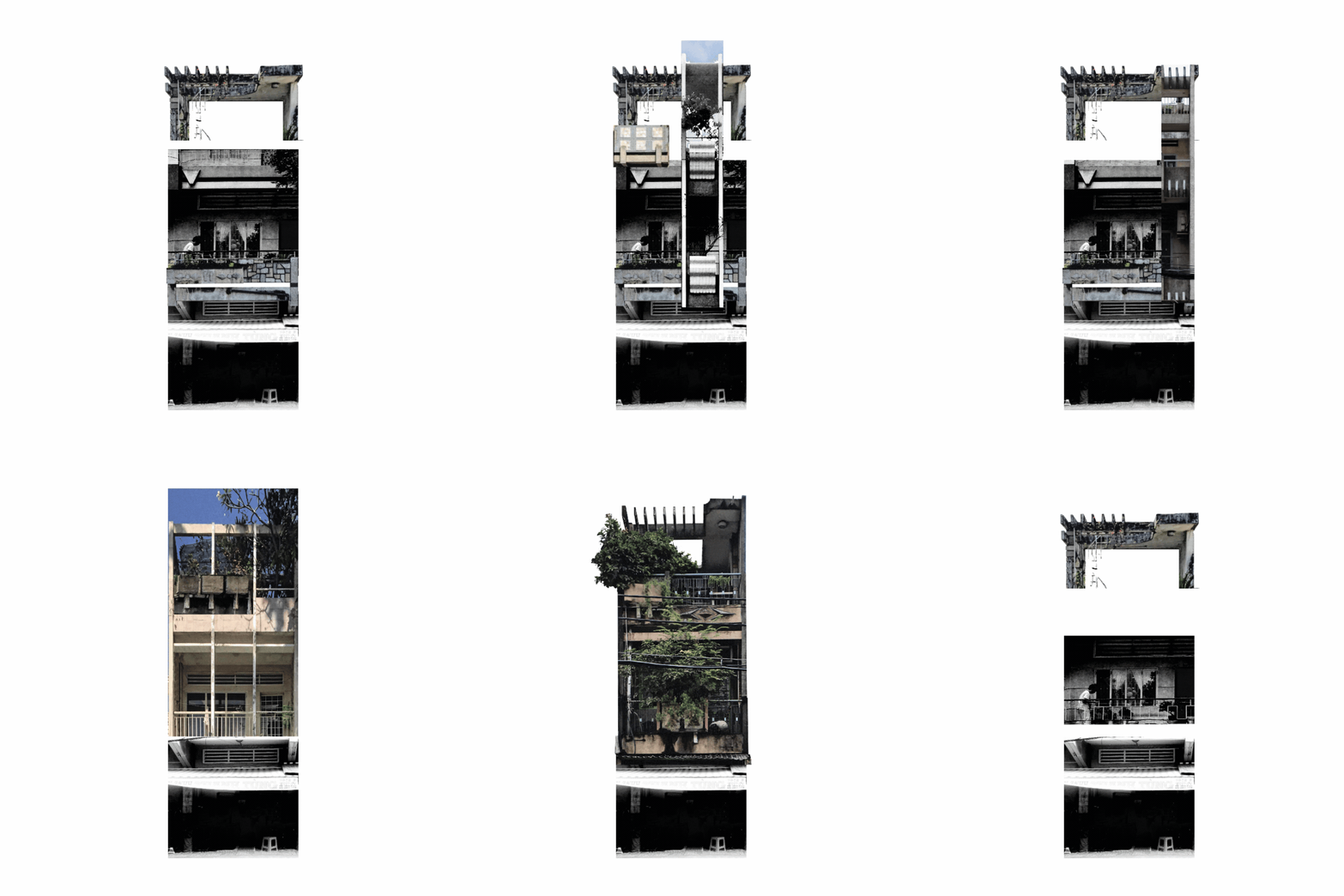
Unexpectedly, during this process, a parallel development of modernism occurred in Vietnam. For the first time, the population had acquired this new language and used it to design their houses in both urban and rural contexts, without architects. Based on generally accepted templates, the general masses crafted artworks of personal expression on the modernist façades of their houses. The micro-climatic devices mentioned above were reinvented once more.

Ordinary creative display of modernist elements by the people. Photo by Phạm Vinh.
From a widespread use of those devices, a unique language emerged. Rather than sophisticated functional calculations, architectonic elements like planters, louvers, brise-soleils are placed intuitively and spontaneously as in a poetic visual game, without losing their purposes. Ordinary people, across Vietnamese regions, using a common grammar and vocabulary built out of functional elements, crafted creative expressions of personal taste for their houses. Consequently, the language of modernist design was domesticated by the local design culture to become a completely independent creative enterprise; a parallel modernism that is popular and without authorship.

Even though Vietnamese vernacular modernism seems spontaneous, there is an underlying structure common to all designs, a kind of generative code, with its own syntax and lexicon that the population uses to create and iterate. Individual results, despite being unique pieces, are recognizable as members of a common language.
Walking through the urban landscape of Saigon today offers a spectacle of individuals who had picked and tweaked the designs of planters, louvers, brise-soleils to their whims, yet somehow always following certain common orders that automatically integrate passive shading and natural ventilation. An element, like a planter, reappears and travels within a city, or even across cities, but not one single planter is identical to the rest. These features made modernism vernacular in Vietnam, due to its intimate relation with the climatic context, as much as to its relation with the cultural characters, one inclined to the joyful play of structure, elements and their interlocking shade.

Planter design with supporting “brackets.”
The architectural landscape became a display of creative conversations. There seems to be a subconscious forum where ideas were exchanged and circulated. Modernist designs then became a collectively lived experience, yielding an unprecedented architectural current that is more spontaneous, natural, poetic and spiritual than what conventional modernist principles would normally tolerate.

Vietnamese modernism represents a distinctive moment within global modernism. For the first time, the modernist language was extracted from an institutional practice by regular people to be reinjected into their building culture. That culture then became an autonomous, yet largely anonymous modernist current.
This phenomenon sheds light on two subconscious cultural processes. First, vernacular practice can exist in modernity, contrary to the public’s generally perceived ideas about modernist movements. Vietnamese modernist architecture makes the case that culturally and environmentally sensitive architectural responses can be achieved within industrial societies. Through a collective climatic intelligence and a particular aesthetics, these structures attach themselves to the practicality and sensuality of Vietnamese living habits.
Second, it explicates a profound aspect of human nature that spans across cultural activities. Almost identical to a natural language, Vietnamese vernacular modernism exhibits the exercise of a strong collective grammar and vocabulary, with expressions embedded with personal tastes, nuances, and inflections, similar to regional accents or individual speech styles.

There seems to exist a more profound mental language of culture, one that dictates across human expressions. As a part of this creative linguistic capacity, Vietnamese vernacular modernism sheds light on how the human spiritual self manifests through physical expressions, as an individual and as a community. In this sense, architecture, beyond being a professional discipline, is a cultural act, the product of a collective conscience.
These characteristics of Vietnamese modernism invite us to reconsider how architectural value is understood. It is not only the “scholarly” architecture practiced by a few, but rather the popular practice that best reflects the built environment’s cultural and geographical codes. Contrary to a kind of formalism theorized by a private group, Vietnamese vernacular modernism is achieved by the masses, from the bottom up, growing naturally as a language system — a living cultural substance that transforms, matures, and evolves according to the community in which it is spoken, a process that gives form to ideas, styles, and tastes, reflecting that community’s singular relationship with reality.
Vernacular modernism in Vietnam also offers a different way to look at architecture history. One has to briefly forget rigid architectural principles to look at design and build as a social and cultural phenomenon. The anonymous speakers of this architectural language were also the anonymous authors of the vast majority of the built environment. Unlike institutional modernism, it gives us a break from elitist and privileged architectural currents to look at the beauty of everyday people’s ordinary “speech.” In doing so, it advocates for the unofficial and unnoticed in architectural history. It pushes us to think not only outside the “scientistic” sphere of architecture, but also beyond the commonly known modernist centers of the world, to consider architecture as an ordinary yet fundamental activity of human expression.
Too little has been said about vernacular modernism in architecture, just as too little has been said about Vietnamese modernism in relation to the world’s. Perhaps it is time to take a leave from over-theorized aesthetics and start finding poetry in ordinary languages.


